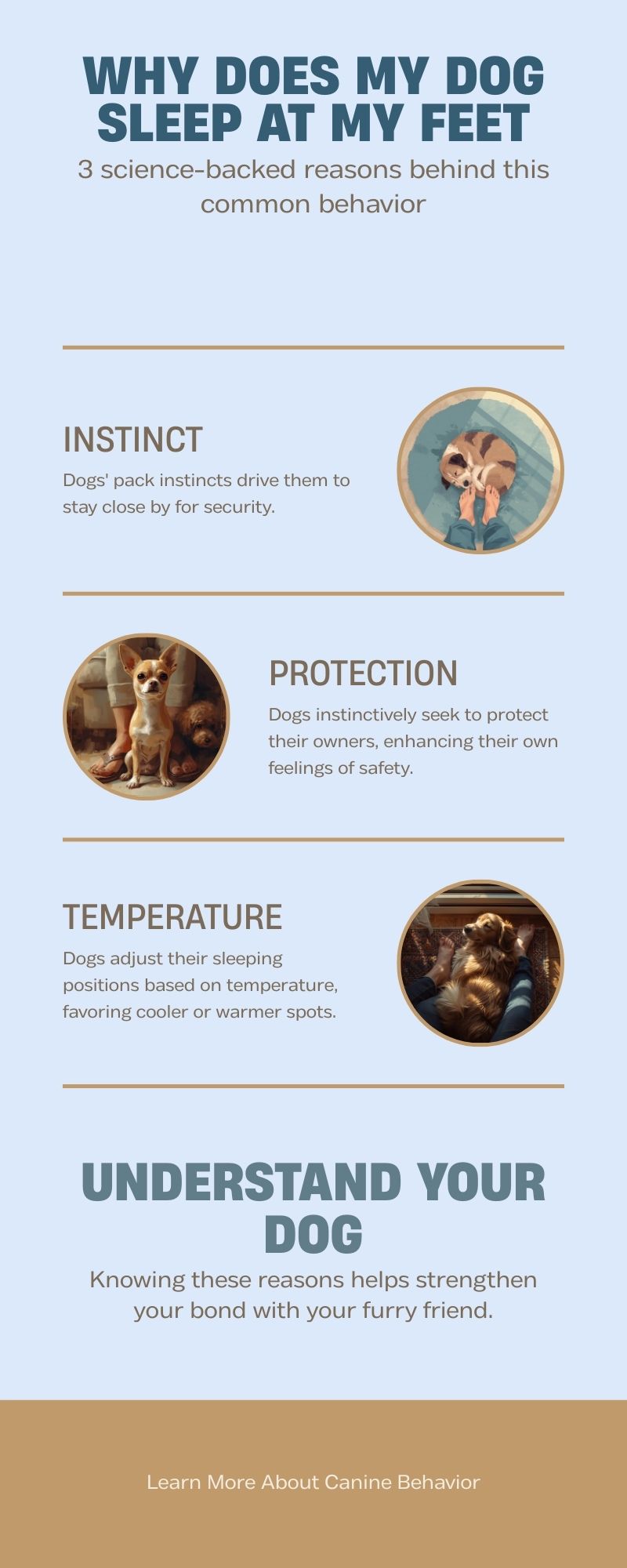


Last Tuesday, I stretched out on the couch for an afternoon nap. Within minutes, I heard the familiar scratch of paws on the cushion, and Milo, my Jack Russell Terrier, had hopped up and curled himself against my feet. Not beside me. Not tucked under my arm. At my feet, pressed against my ankles, his chin resting on my heel. By the time I woke up an hour later, he had not moved an inch.
I lay there for a moment, staring at the ceiling, thinking: of all the places on this couch, why there?
It turns out, the answer runs deeper than comfort or habit. And it was not his first time. A lot of pet owners experience the same situation. And often, they ask themselves, why does my dog sleep at my feet? Well, let’s try to find the answer!

What your dog is actually communicating
Dogs have been sleeping alongside humans for at least 15,000 years, possibly longer. Long before they had plush orthopedic beds or fleece blankets, they were sleeping pressed against their pack — for warmth, for protection, and because proximity itself was a form of survival.
That instinct has not disappeared. It has just relocated to the foot of your bed.
When your dog sleeps at your feet, they are not confused or lost or running out of options. They are making a deliberate choice. Your feet carry more of your scent than almost anywhere else on your body. To a dog, that scent is the sensory equivalent of a weighted blanket. Dr. Alisha Kidwell, a veterinarian at Cabarrus Animal Hospital in North Carolina, describes a human’s scent as exactly that — familiar, soothing, calming during anything that disturbs the night.
So the first thing to understand is this: the foot of your bed is not a consolation prize. For a dog, it might be the most carefully selected spot in the entire house.
The reasons behind the behavior
There is rarely a single reason a dog sleeps at your feet. More often, it is a combination of instinct, temperature, trust, and habit that settles them there night after night.
Pack instinct
Dogs are social animals. Their wild ancestors slept huddled together in groups — not because they were affectionate in the way we think of affection, but because sleeping alone was dangerous. That wiring persists. Certified professional dog trainer Elliot Rosenberg of K9 Mania Dog Training describes it plainly: “In their eyes, being close enough to touch symbolizes security and unity.” When your dog positions themselves at your feet, they are placing themselves within the pack boundary. You are the anchor. They are staying close to it.

Looking for Protection
This one surprises people because small dogs do it just as readily as large ones. A Chihuahua sleeping at your feet is not guarding you in any practical sense, but the instinct driving the behavior is the same as the one that drives a German Shepherd to sleep facing the door. Research from Arizona State University’s Canine Science Collaboratory found that dogs increase stress behaviors and protective responses when their owner is in distress, showing emotional contagion between dogs and their humans. The foot of the bed — or the foot of the couch — is a strategic position. It faces outward. It gives a dog an unobstructed view of the room and access to any exit.
Temperature regulation
Dogs are more sensitive to heat than people assume. A thick-coated breed, or any dog running warm, will actively avoid sleeping against your core and choose your feet instead. Feet radiate less body heat than your torso. For a dog prone to overheating, that lower temperature is the point, not a problem. In colder months, the same logic applies in reverse — smaller dogs and short-coated breeds press against your feet specifically for the warmth.
Anxiety and comfort
A dog going through a stressful period — a new home, new people in the house, a disrupted routine — will often gravitate toward their owner’s feet as a coping mechanism. Your presence lowers their cortisol. A study published in Frontiers in Veterinary Science on separation-related problems found that dogs seek proximity to their primary attachment figure as a core stress response. The foot of the bed keeps them close enough to monitor you without competing for space near your body. For a dog prone to anxiety, that proximity is what allows them to sleep at all.
Habit and reinforcement
Dogs are fast learners, including when it comes to what earns them comfort and closeness. Elliot Rosenberg notes that dogs quickly identify which behaviors increase their access to their person. If settling at your feet gets them a hand dropped down to scratch their ears, or simply keeps them near you through the night, they file that away. The behavior becomes routine. Routine becomes preference. Eventually, it becomes the thing they do — every night, without thinking about it, the same way you favor one side of the bed.
Do dogs sleep with their favorite person?
Yes, and they are usually deliberate about it.
In multi-person households, dogs tend to seek out whoever they feel most secure with at night. That is often the person who feeds them and trains them, but not always. Sally Grottini, a dog trainer and behaviorist, explains it this way: if a dog has an anxious temperament, they gravitate toward whoever is most consistent in the home, not necessarily whoever spends the most time with them.
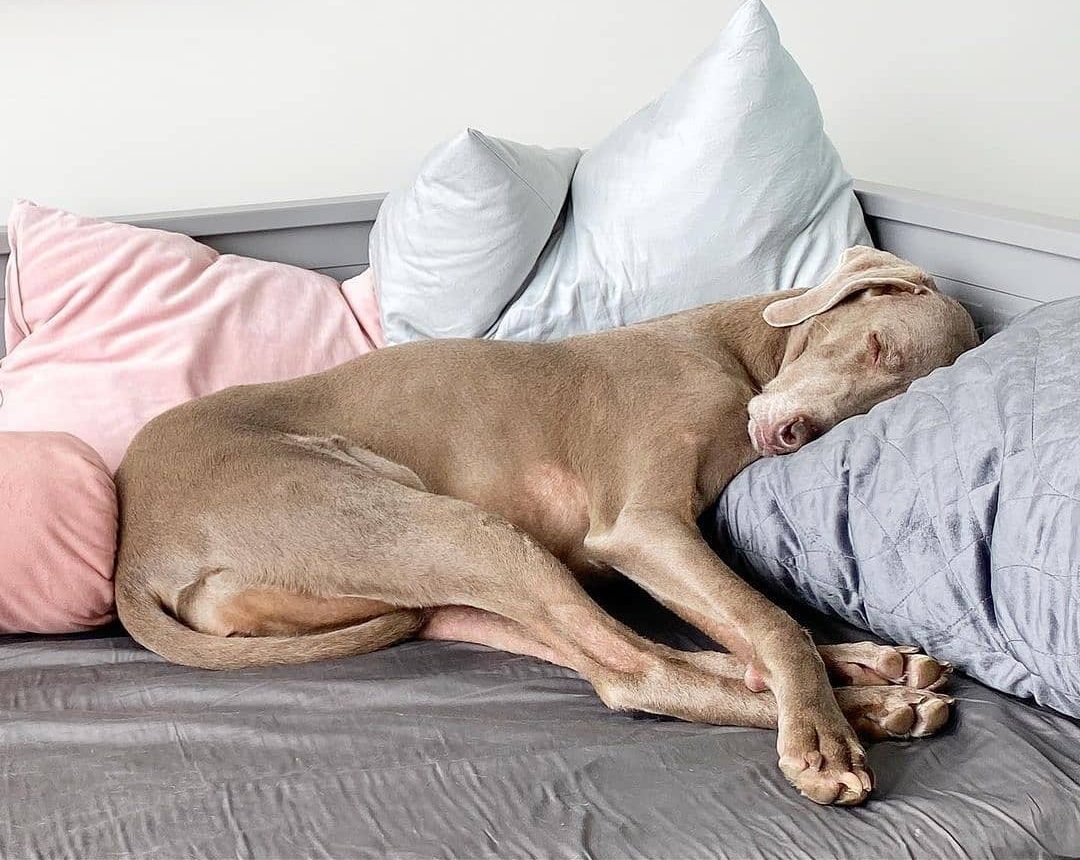
Research by Dr. Christy L. Hoffman at Canisius University, based on a study of over 1,000 dog owners, found that when two people shared a bed with a dog, the dog typically settled at the humans’ feet — presumably where space was most available. In single-person beds, however, dogs shifted to sleep at chest level, occupying the position where a human partner would lay. The dog fills the space carrying the most warmth and scent. They are not random about it.
Hoffman’s earlier study, published in Anthrozoös, surveyed 962 women and found that dogs were perceived to disturb sleep less than human partners, and were associated with stronger feelings of comfort and security.
What this means practically: if your dog consistently bypasses one person in the house to sleep at another person’s feet, that is information. It does not mean the bypassed person is failing at anything. It usually means the dog has formed a closer attachment — and that attachment is built through daily interactions, positive training, calm handling, and consistency over time.
What does it mean when your dog sleeps at your feet?
The short answer: it is a compliment.
A dog that sleeps at your feet has decided that your presence is worth losing their solo space over. They have weighed the options and chosen proximity to you. That is trust expressed physically, in the only language dogs have available to them.
There are some situations where the behavior warrants a closer look. If your dog has only recently started sleeping at your feet after never doing so before, something may have shifted — a stressor, a change in the household, or the early signs of separation anxiety. Signs to watch for include distress when you get up and move, inability to settle anywhere except on or against you, or a pattern of following you room to room during waking hours. These are not reasons to stop your dog from sleeping at your feet, but they are reasons to pay attention to their overall stress levels and consider whether they would benefit from more independence-building in daily life.
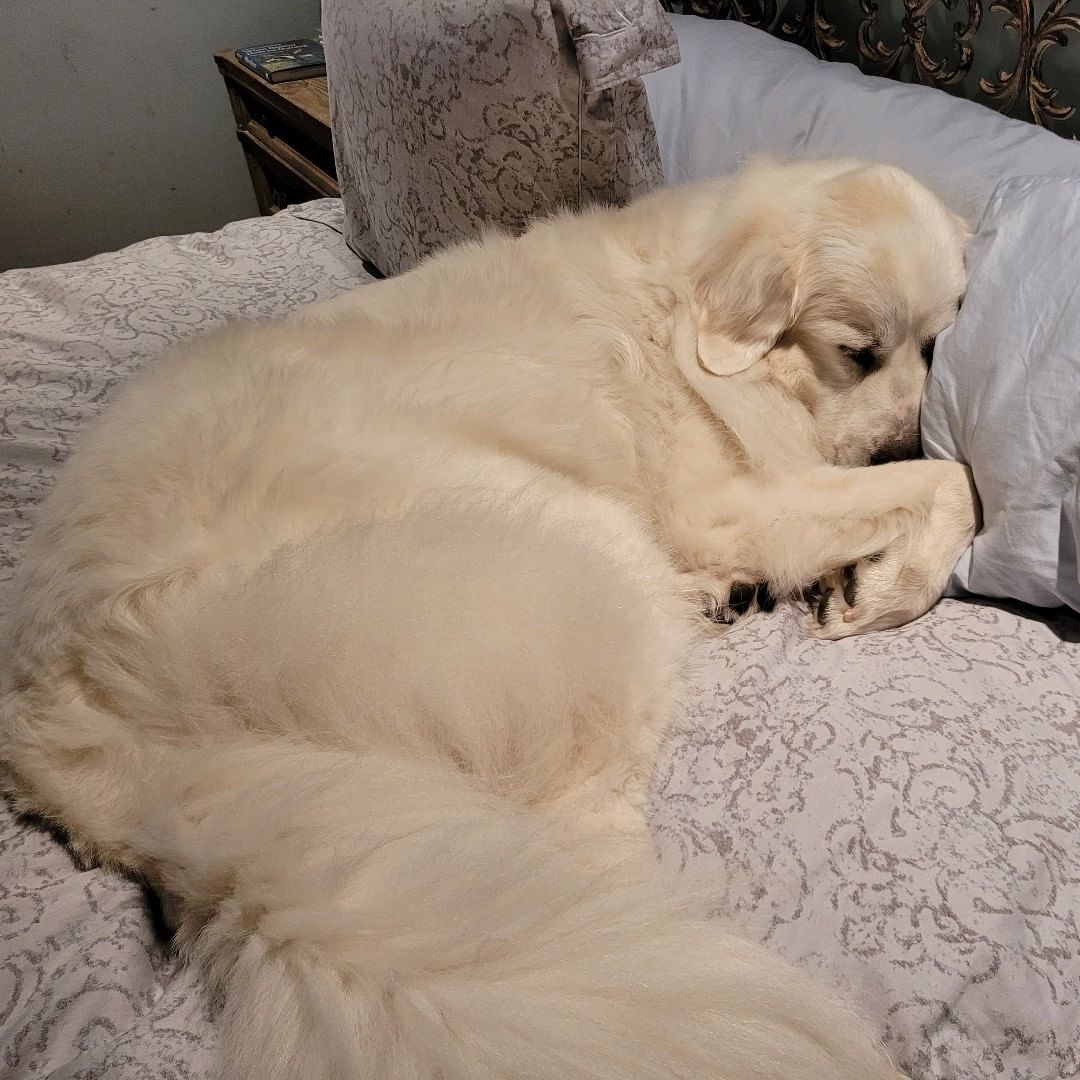
Resource guarding is a separate concern. If your dog growls or snaps at other people or pets that approach your feet while they are resting there, that behavior needs to be addressed with a trainer, regardless of how the sleeping arrangement came about.
But absent those signals, a dog sleeping at your feet is simply a dog that feels safe. They have chosen the position that keeps you in range — close enough to monitor, close enough to respond, close enough to feel your warmth and smell your scent through the night.
Should you let them stay?
Hoffman’s Canisius study found that more than 65% of dog owners reported their dog rarely or never disrupted their sleep. Her 2018 research in Anthrozoös found that people who slept with dogs self-reported greater comfort and security compared to those sharing with a human partner.
Whether to let your dog sleep at your feet comes down to your specific situation. If you sleep through it and they sleep through it, there is nothing to fix. If the arrangement is causing disrupted sleep, hygiene concerns, or behavioral issues, there are straightforward ways to redirect the habit — a dog bed placed directly beside yours, a consistent bedtime routine, and positive reinforcement when they use their own space.
The dog at your feet is not confused about where they belong. They have already figured that out. The question is just whether you want to share the space.
Most nights, the answer is probably yes.