

If you’ve ever watched a Great Dane try to fold itself onto a dog bed clearly built for a Beagle, you already have a sense of the problem. Big dogs carry a lot of weight through joints that, structurally, aren’t all that different from a small dog’s. A Labrador’s hip is the same basic design as a Chihuahua’s, just scaled up and asked to do a lot more work.
That mismatch between size and structure is a big part of why large and giant breeds, Labs, German Shepherds, Great Danes, Mastiffs and the like, end up with joint problems far more often than their smaller cousins. The good news is that a lot of this is predictable, and predictable means preventable, at least to a degree. Here’s what’s actually going on, and what you can do about it before your dog is the one struggling to get up off the floor.
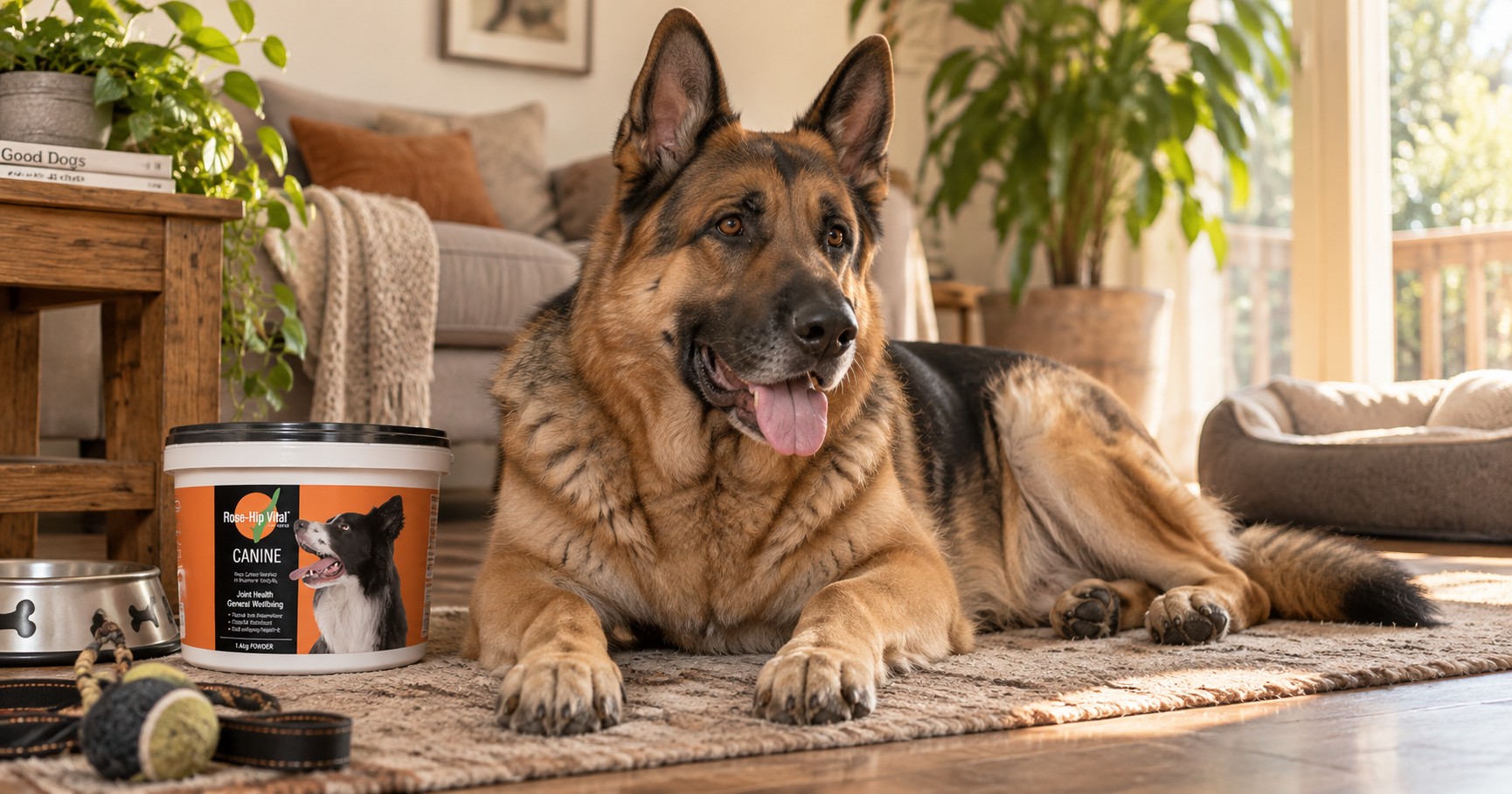
The Simple Physics of a Bigger Dog
Every extra pound of body weight adds real force to a joint every time a dog walks, jumps, or turns. A 70-pound German Shepherd puts several times more pressure through its hips and elbows with each stride than a 15-pound terrier does, even though the joint itself isn’t built any sturdier to compensate.
Cartilage wears down under repeated load the same way brake pads wear down on a heavy truck faster than on a compact car. Over years, that extra force adds up to more cartilage loss, more inflammation, and earlier arthritis in dogs that are otherwise perfectly healthy. It’s not that large breeds have worse joints. It’s that ordinary joints get asked to handle extraordinary loads.
Growth Spurts That Outpace Joint Development
Puppyhood is where a lot of the damage actually starts, long before symptoms show up. Large breed puppies can gain more than a pound a week during their growth phase, and their skeletons are still soft and developing while all that mass piles on.
Bones, tendons, and the joint capsules that hold everything together don’t always mature at the same rate the body weight does, so a fast-growing puppy can end up with joints that are structurally underprepared for the frame they’re supporting. This is part of why hip and elbow problems in large breeds often trace back to something that happened, or didn’t happen, in the first year of life, not to old age itself.
Genetics Load the Dice
None of this happens in a vacuum. Hip dysplasia and elbow dysplasia are strongly hereditary, and they show up disproportionately in the same handful of large and giant breeds generation after generation. A poorly formed hip socket or an uneven elbow joint is something a puppy is essentially born with, inherited from parents who may have looked perfectly normal on the outside.
Reputable breeders screen for this with hip and elbow scoring, and it’s worth asking about those results before bringing home a large breed puppy. Even so, good genetics only set the ceiling. What happens in the first two years still determines how close a dog gets to that ceiling or how far it falls short.
Feeding and Exercising Puppies With Joints in Mind
Because rapid growth is one of the biggest controllable risk factors, feeding matters more for large breed puppies than owners tend to expect. Large breed puppy formulas exist specifically because they control calcium and calorie levels to slow growth to a steadier, joint-friendlier pace, rather than maximizing size as fast as possible. Free-feeding or overfeeding a big breed puppy, even with a good food, tends to push growth faster than the skeleton can safely keep up with.
Exercise deserves the same caution. It’s tempting to take a boisterous young Lab or Shepherd on long runs, but repetitive high-impact activity on joints that haven’t finished forming does real damage that doesn’t show up until years later. Short, low-impact play sessions and controlled leash walks are a better bet until a dog is closer to physical maturity, which for giant breeds can mean eighteen months or more.
Protecting Joints Once They’re Grown
Once a large breed dog is fully grown, the job shifts from managing growth to managing wear. Keeping an adult dog lean is probably the single most effective thing an owner can do, since excess weight puts the same kind of extra strain on joints as it does in a puppy, just over a longer timeline. A body condition check with your vet twice a year is a cheap way to catch creeping weight gain before it becomes a habit.
It’s also worth starting joint support earlier than most owners assume, well before limping or stiffness ever appears, rather than waiting for a problem to react to. Vets often recommend nutritional support built around ingredients like glucosamine, omega-3s, or rosehip based on GOPO, since it’s been studied for helping calm the inflammation that wears joints down over time.
Products like natural joint supplements for dogs fall into this category, and for large breeds with a known predisposition, that kind of daily support can reasonably start in early adulthood rather than at the first sign of trouble.
The Bottom Line
Large breeds face more joint problems because of a combination that’s hard to avoid entirely: more body weight moving through ordinary joint structures, growth rates that can outpace developing bone and cartilage, and genetics that predispose certain breeds to hip and elbow issues in the first place.
You can’t rewrite genetics, but you can control how fast a puppy grows, how hard you push young joints before they’re ready, and how lean and supported those joints stay once your dog is an adult. Start those habits early, keep them consistent, and daily nutrition built around joint health becomes just one more normal part of caring for a big dog, not a reaction to one that’s already struggling.